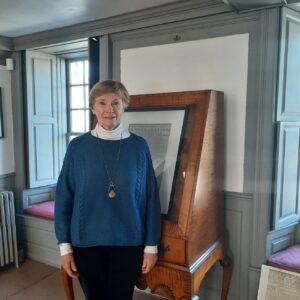

Working statewide for many years with various nonprofits as a volunteer, nonprofit consultant, and in leadership roles as a staff member, longtime Exeter resident Karen Prior took a step closer to home in 2024. She took this step at the behest of Dr. Judy Rowan, who called to invite her to join the board of the American Independence Museum (AIM).“I was like, ‘yes,’” recalls Karen. “I had been frustrated by the national dialogue, the lack of civil engagement, and the polarization. I wanted to make a difference, even in some small way.”
For Karen, the idea of fostering a more civil society resonated deeply, as it mirrored her private reflections on the current state of democracy and the need to rediscover the core principles of respect and inclusivity.
“What is democracy?” she rhetorically notes. “How do we support one another? How do we do better?”
When Karen began her onboarding process at AIM, she credits an initial conversation with Executive Director Jennifer Carr and Board Member Joe Pace, who is now President, as transformative.“Jen especially got me fired up,” explains Karen. “She was so inclusive in her approach. We need to tell the full story of the Revolution, how the country came to be, and how we bring these conversations forward in an inclusive way.”
Her renewed excitement was not just about history. Rather, it was about making AIM relevant and exciting for today’s audience. “We need to fire people up around the story,” she says.
Exeter, once the capital of New Hampshire during the American Revolution, houses seminal historical artifacts such as a Broadside copy of the Declaration of Independence and working drafts of the US Constitution. “It’s a jewel in the crown of the state, and no one knows about it,” she adds.
Karen sees the 250th anniversary of American independence in 2026 as a pivotal moment for AIM. “We’ve got the nation’s 250th coming up,” she notes. “If we’re not put on the map by then, we’re missing an opportunity.”
For her, this anniversary is not just about looking back—it is about using history as a springboard to foster civil discourse and engage the public in meaningful, relevant ways.
“We have to start having these intense conversations to build bridges,” she says. “The organization has two huge charges in front of it—delivering incredibly important programming and maintaining the historic buildings. We need to get more people engaged in both.”
Karen’s belief in the power of dialogue is at the core of her involvement at AIM, as she acknowledges she is increasingly concerned about the state of discourse in today’s society. “Can we have a dialogue where we discuss opposing viewpoints in a civil way?” she asks.
Karen draws inspiration from New Hampshire Listens, an initiative out of UNH that trains facilitators to guide civil discussions. “You get two people together, and there’s always disagreement,” she notes, “but it’s become so uncivilized. How do you build a better democracy?”
This question can be explored at AIM. “Let’s really look at the facts of what happened, but it’s got to be inclusive of all voices—people of color, women, people who identify as part of the LGBTQ+ community, and other marginalized people,” she states.
Karen’s passion for inclusive history also stems from her belief in the power of artifacts to connect people with their past and future. “Our artifacts speak to our souls,” she says. “They are jumping-off points for conversation, and the more informed we are, the more impactful those conversations become.”
These conversations can find a home at AIM. “We have a chance to be a change agent in New Hampshire and beyond,” she says. “I believe we can build bridges to our past and our future.”